
Your Next Upgrade Awaits: fake rolex GMT Master watches in the USA
The GMT Master Replica Decision: What Actually Separates a $600 Watch from a $2,000 Mistake
Most people who start looking at a rolex GMT Master replica spend their first week comparing dial photos. They zoom into the rehaut, count the bezel clicks in a video, and screenshot side-by-sides. Then they buy from whichever seller has the cleanest product page. In my experience, that sequence is exactly how buyers end up disappointed. The watches that look identical in a listing photo are often built around different movement architectures, assembled by factories whose status changes month to month, and shipped through channels that carry real risk of a customs letter instead of a watch. The decision is not about which one looks best online. It is about which combination of factory, movement, and seller survives six months on your wrist.
Why the GMT Master Is the Hardest Rolex to Replicate Well
The GMT-Master II is not a Submariner with an extra hand. It is a more complex watch, and that complexity is where replica quality diverges most sharply. A Submariner replica only needs to look like steel, look like black ceramic, and run a three-hand movement. A GMT Master replica has to deliver a bidirectional 24-click bezel with a ceramic insert whose two colors meet at a precise line, a hand stack in the correct order, and a movement that keeps two time zones synchronized without drift.
From what I have seen, the bezel is where budget GMT builds announce themselves first. A cheap Pepsi insert does not just have a softer color transition at 6 and 18. It feels hollow when you rotate it, with a click that sounds like a ratchet rather than a machined detent. The hand stack is the second tell. On a correct build, the hour hand sits closest to the dial, then the minute hand, then the GMT hand, then the seconds hand on top. Older or cheaper builds get this order wrong, and the error is visible from a normal viewing angle once you know what to look for. The third tell is the lume fill on the bezel numerals; on a good ceramic insert it sits flush and slightly recessed, while on a cheap one it looks painted on and catches light unevenly.
So what does this mean for a buyer? It means the GMT category rewards buying from a factory that has specifically engineered the GMT platform rather than adapting a Submariner movement. A replica rolex GMT Master from a factory that treats GMT as a side product will almost always have a bezel action or a hand-stack compromise that a dedicated GMT builder avoids. This is why the factory conversation matters more here than in almost any other replica category, and why the cheapest listing is rarely the one you want.
The Factory Landscape in 2026: Clean Is Not What It Was, and the Alternatives Are Not Equal
If you search for a fake rolex GMT Master watches today, you will still see Clean Factory recommended in older threads, older videos, and a surprising number of current listings. That recommendation is out of date, and the gap between what buyers expect and what they receive is one of the most common sources of frustration I have seen in the past year.
Clean Factory was, until mid-2025, the benchmark for Rolex sports replicas, including the GMT Master replica. Community records show the factory was reported raided in July 2025, and by February 2026 the community “Who Makes the Best” guide had removed Clean entirely. What remains is a confusing aftermarket of “Clean” listings that are, depending on who you ask, leftover pre-raid stock or a newer operation using the name with no verified connection to the original. A commenter in mid-2026 summarized it bluntly: when a buyer asks for Clean, some dealers treat it as bait and then suggest another factory because Clean is “not in production.” That does not mean every Clean-labeled GMT is a scam. It means the name no longer functions as a quality guarantee.
VSF and C+ are the two names that currently matter for GMT buyers, and they are not interchangeable. VSF’s GMT line is built around the Dandong 3285 and has a reputation for stability and low return rates. C+ is a separate factory from what is sometimes sold as “Clean Plus,” and the community guide in May 2026 placed C+ second for the GMT-Master II 116710LN. In side-by-side testing, C+ and VSF are close enough in external finish that social-distance comparison is genuinely difficult. Both use 904L steel, both have credible ceramic inserts, and both align the date and rehaut correctly. The meaningful difference is inside the case, and that is where the movement decision becomes unavoidable.
Factory positioning for the replica rolex GMT Master, as of late 2026:
- VSF: Dandong 3285, strongest stability track record, 72-hour power reserve, widely available.
- C+: Shanghai 3285 free-sprung variant, different balance architecture, reportedly shorter power reserve on some batches.
- “Clean” labeled stock: treat as unverified. Individual examples may be fine, but the label carries no reliable factory backing.
- BT and other mid-tier names: mixed catalogs, not GMT specialists. Verify the specific reference before buying.
The Movement Question: DD3285, SH3285, and Why the Spec Sheet Does Not Tell You What You Need to Know
Here is where most buying guides stop at a name and a number. “DD3285, 72 hours, 1:1 clone” is the standard line. It is accurate as far as it goes, but it does not explain why two watches with the same movement designation can behave differently, or why a buyer who paid for DD3285 might be wearing something else.
The Dandong 3285 is the current high-water mark for the rolex GMT Master replica. It is a 1:1 clone of the Rolex Caliber 3285 in the sense that the bridges, gear train layout, and key functional components follow the genuine architecture rather than being a modified generic movement with a GMT module bolted on. The power reserve is 72 hours, the beat rate is 28,800 vph, and the independent hour hand adjusts in the correct direction with the correct jump behavior. In practical owner use, the DD3285 is the movement that makes the “take it off Friday, put it on Monday” routine actually work. Return rates reported in community channels are low relative to earlier generations, and parts interchangeability with genuine-spec components is high enough that a competent watchmaker can service one without hunting for unobtainable pieces.
The complication is that DD3285 has become a marketing term as much as a technical description. The Shanghai 3285 is a different movement, and it has been sold with cosmetic modifications intended to pass as DD3285. The differences are visible if you know the tells. The red wheel on the SH3285 sits higher off the base plate and is a brighter red. On the DD3285 the red wheel sits nearly flush. The semicircular plate under the balance with the “ROLEX” engraving is polished on the DD3285 and unpolished on the SH3285. The decisive difference is the golden screw on the balance bridge: on the SH3285 it can be fully unscrewed with a screwdriver, while on the DD3285 it is constructed so that it cannot be completely removed. None of these checks require opening the case back beyond what a watchmaker would already do for inspection.
The C+ free-sprung Shanghai 3285 adds another layer. It uses a single regulating column and balance weights, which is closer to the genuine free-sprung visual layout, and it has a stop-seconds function. But its power reserve is reported closer to 45 hours on some batches, not the 72 hours of the DD3285. For a daily-worn watch, that difference matters less than the stability question. From what I have seen in owner reports, the DD3285’s longer track record in the field makes it the lower-risk choice for a first GMT Master replica, especially for a buyer in the USA who does not want to ship a watch back across an ocean for a warranty claim that may not be honored.
A comparison worth making explicit: VSF’s DD3285 build versus C+’s Shanghai 3285 build is not a case of one being better in every dimension. The VSF gives you the proven movement, the 72-hour reserve, and the broadest service familiarity. The C+ gives you a free-sprung visual layout and stop-seconds. If you never open the case back and you wear the watch daily, the VSF’s movement advantages are more relevant. If you care about the movement’s visual fidelity through a display back or you specifically want stop-seconds, the C+ has a defensible case, provided you accept the shorter reserve and the less-established long-term service picture.
Two Buyer Mistakes That Cost Real Money
The two errors below account for most of the disappointment I have seen among GMT buyers, and both share the same root cause: treating a label as a substitute for verification. Neither mistake is about picking the wrong factory. They are about picking the right factory name and then assuming everything downstream is automatically correct. That assumption is where money gets lost.
Mistake One: Treating “1:1 Clone” as a Quality Grade
The phrase “1:1 clone” gets used to describe everything from a genuine-architecture DD3285 to a movement that shares the external dimensions of the original but none of the internals. I have seen buyers pay DD3285 money for a watch that arrived with an SH3285, and the seller’s defense was simply that the listing said “1:1 clone 3285.” The phrase is not regulated, not standardized, and not a substitute for knowing which movement you are buying. The practical impact is that you cannot use “1:1 clone” as a sorting criterion. You have to ask the seller which movement is inside, and you have to know enough to verify it. The red-wheel height and the balance-bridge screw are not deep forensic details; they are basic inspection points that separate a DD3285 build from a cosmetically dressed alternative.
Mistake Two: Buying the Factory Name Instead of the Current Batch
This is the Clean trap, and it is wider than most buyers realize. Clean built a decade of goodwill, and that goodwill is now being used to move stock that may or may not have anything to do with the original operation. The raid reporting, the removal from community guides, and the emergence of unverified “Clean Plus” branding all point to the same conclusion: the name is no longer a reliable proxy for the watch in the box. From what I have seen, the buyers who end up happiest stop asking “is this Clean?” and start asking “who built this specific movement, and who is standing behind the sale?” A VSF GMT with a documented DD3285 and a seller who answers questions after payment is a lower-risk purchase than a “Clean” GMT from a seller who disappears once the tracking number goes live.
Wrist Test vs Macro Test: The Distinction That Should Drive Your Budget
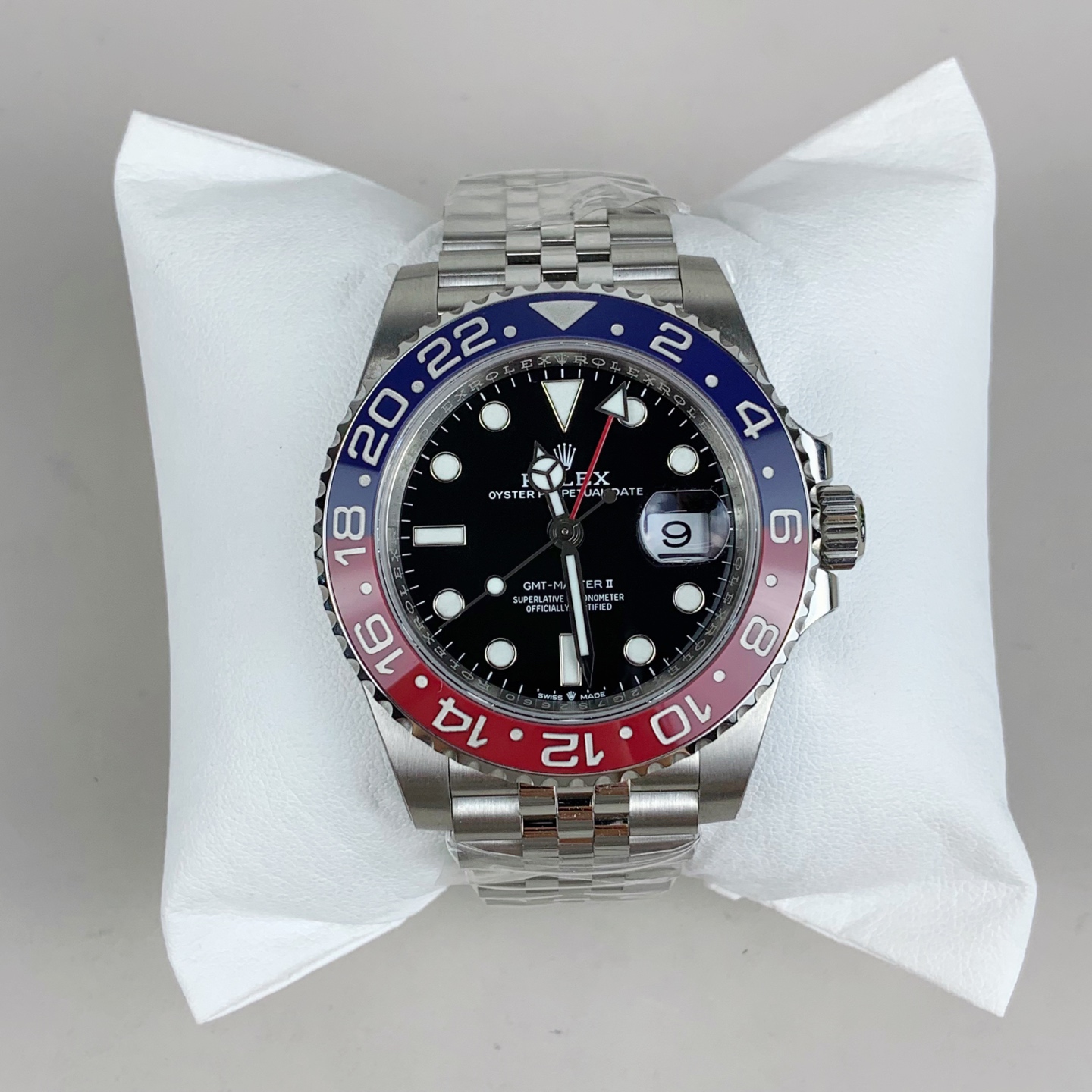
Most replica reviews, including many I read before buying my first GMT, are macro tests. They compare lume plots at 10x, measure bezel engraving depth, and debate whether the blue on a Pepsi insert is 2% too purple. These tests are useful for understanding how close a factory has come to the original in absolute terms. They are almost useless for deciding what you should buy, because you do not experience a watch at 10x magnification. You experience it on your wrist, at arm’s length, under office lighting and direct sun and the mixed light of a restaurant.
The wrist test asks different questions. Does the bracelet articulate without grabbing your wrist hair? Does the clasp close with a solid click and stay closed? When you rotate the bezel, does it feel like a machined mechanism or a loose ring? Does the watch keep time well enough that you are not resetting it every third day? Does the date change cleanly at midnight or does it sit half-flipped for two hours? These are the things that determine whether you wear the watch or leave it in a drawer.
I have handled a C+ GMT that passed every macro test I could throw at it and still felt slightly hollow when the bezel turned. I have worn a VSF DD3285 for weeks without resetting it beyond a few seconds of drift. Neither observation would appear in a photo comparison, and both are more relevant to the purchase decision than a 5% difference in insert color accuracy. The practical rule I would give a first-time buyer is this: spend your research time on movement identity and seller reliability, not on macro-level cosmetic differences between two factories that are both above the obvious-fake threshold. The wrist test is the one you will actually live with.
Buying in the USA: What the Watch Costs After the Watch
A fake rolex GMT Master for sale in the USA carries considerations that do not apply to buying a Seiko. The legal picture is frequently misstated in both directions. Personal-use possession of a replica watch is generally not criminally prosecuted in the US, but importing counterfeit goods is a different matter, and customs authorities do seize shipments at ports of entry. Seizure records from 2025 and 2026 show Rolex GMT-Master II counterfeits among the items intercepted at express consignment facilities in Oakland, San Francisco, and Chicago. The risk is not theoretical, and it is not evenly distributed across sellers.
This is where the seller question becomes operational rather than abstract. A seller who has experience with US-bound shipments will understand packaging, declared values, and the difference between a channel that clears reliably and one that generates customs letters. A seller who treats every order the same way is gambling with your money. I have seen buyers receive a watch in ten days and I have seen buyers receive a seizure notice and a seller who stops responding. The difference was almost never the watch. It was the shipping operation behind it.
In my own purchasing, I have used replicafactory.cx for GMT orders after comparing their movement documentation and their response pattern on pre-sale questions. They are not the only seller worth considering, but they have been consistent in my experience on the things that matter for a US buyer: confirming the actual movement before payment, providing tracking that updates, and responding when the inevitable “where is it” question comes up. For buyers who want a second reference point on replica rolex GMT Master watches across factories and batches, the rolex gmt master replica collection is a useful cross-check for comparing current listings and reference numbers, though as with any aggregator, verify the movement independently before committing.
The cost calculation also needs to include service. A DD3285 that develops an issue after six months is serviceable by a competent local watchmaker if parts are available. An obscure movement from an unverified factory may not be. For a US buyer, the difference between a $600 watch that can be serviced for $150 and a $450 watch that becomes a paperweight is not a saving. It is a more expensive mistake.
The Recommendation I Would Give a Friend
If you want a GMT Master replica you can wear without thinking about it, the lowest-risk configuration in the current market is a VSF build with a verified DD3285, bought from a seller who will confirm the movement and has a track record of US delivery. That combination does not win every macro comparison, and it is not the cheapest option. What it does is minimize the three failure modes that actually ruin the ownership experience: a movement that is not what you paid for, a bezel that feels wrong every time you touch it, and a shipment that never arrives.
If you specifically want the free-sprung visual layout and stop-seconds, the C+ Shanghai 3285 is a legitimate alternative, but go in knowing that you are trading some power reserve and some long-term service familiarity for that architecture. If you find a “Clean” GMT that looks perfect and is priced like a premium watch, ask the seller to document the movement and the batch. If they cannot, walk away. The rolex GMT Master replica watches market rewards patience and punishes name recognition. The watch you want is the one with the right movement inside, not the one with the most familiar label on the listing.
